Posts Tagged ‘psychotherapy’


seeing through a new lens
I’m not sure where I heard the following tale, but I’ve thought of it often over the years:

A boy and girl crept into their grandfather’s bedroom as he slept, and they smeared a healthy dose of potent smelling cheese across his mustache. When the grandfather awoke, he said, “Oh goodness, this room smells like cheese.” As he descended the stairs, he said aloud, “Oh goodness, this whole house smells like cheese.” He then picked up his pace, rushed toward a window, flung it open and stuck his head out into the morning air. A terrible look came upon his face as he exclaimed, “Oh my goodness gracious, the whole WORLD smells like cheese.”

The instructive value of seeing how the cheese determined what the grandfather could smell in the world is the analogy we can make to how the ‘lens’ through which we look at life determines what we ‘see.’

how we view reality

perspectives from philosophy

Frederick Nietzsche wrote about perspectivalism, the idea that his fellow philosophers’ ideas (and presumably his own) were basically expressions of their own autobiographies. I think he’d agree that the same is true with all of us, that when we make declarations about what we think is true about life and the world, we are communicating much about who we are, how we think and what our character consists of.

Thomas Kuhn wrote about paradigms; he became famous for arguing that scientists were beholden to the paradigm (worldview) that dominated their time/place in history. In this way, Kuhn challenged the idea of universal scientific objectivity.

Ludwig Wittgenstein began his career arguing the merits of objective logic but ended his career by outlining a new method of philosophy designed to change peoples’ “ways of seeing.”

perspectives from psychotherapy

Aaron Beck, one of the founders of the cognitive revolution in psychotherapy used the word schema to refer to the underlying ways in which we humans see and interpret the information in front of us. Our schema, he said, determines whether we have constructive or destructive expectations about our lives.

Jeffrey Young, a student of Beck’s, went on to create what he called schema therapy, a therapeutic approach built upon these ideas.

Albert Ellis, another of the founders of the cognitive revolution in psychotherapy, spoke often about how a large segment of psychological problems stemmed from our natural inclination as children to adopt views of ourselves (and the world) that, in adulthood, turned out to be very self-defeating. Such toxic (neurotic) lenses, he argued, served to distort reality, obscure possibilities and render people miserable.

through what lens are you viewing yourself, the world and your future?

Is your current lens over-determined by (1) the opinions that others had/have about you and your life; (2) hardships and challenges you have faced; (3) the relentless barrage of media, advertising and consumer culture?

Does your lens need some upgrading? Do you need to make it a bit less self-defeating and a bit more life-building?

self-defeating lens life-building lens
1. I must please others and win approval in order to feel good about myself. 1. My intention is to be true to myself as I also try to exhibit love and respect toward others.
2. I must be perfect and make a good appearance at all times. 2. I am aware and accepting of my strengths and limitations, my assets and my vulnerabilities.
3. People are not to be trusted and I must protect myself from them. 3. I can learn to trust worthy people and to take care of myself in relationships.
4. It’s not ok to let go and live spontaneously. It’s not safe for me to let down my guard. 4. It’s ok to let go and be more spontaneous. It’s good for me to take healthy emotional risks.
5. The future is basically bleak and scary. 5. What the future holds depends mostly on how I live, one day at a time.

These are just examples – there are many ways to describe the different lenses we can utilize as we go about the business of living.

Life requires that we take responsibility for the lens through which we view ourselves, our lives and the world. The good news is – while life will never be perfect or pain-free – as we upgrade our lens, we begin to see opportunities and possibilities that we were previously blind to.

compare/despair – a toxic habit

One of the most common and most destructive mental habits that I see people suffering from in my therapy practice is that of habitually comparing themselves to others – and feeling terrible in the process. To do this occasionally is normal and unavoidable; however, when this occupies too large a part of one’s automatic psychological functioning, it exacerbates depression, anxiety, self-defeating behaviors, negative self-concept and other unhealthy realities.

How often do you compare yourself to others’…

  • …appearance?
  • …possessions?
  • …life circumstances?
  • …romantic relationships?
  • …finances and career?
  • …personality?
  • …neighborhood and apartment?

There are endless ways in which we tell ourselves that we are “less-than” others, that we are “not-enough” or that we “do not have enough.”

Years ago I was talking to a friend and I was going on and on about my own drama in relation to what someone else was going through.

He sighed knowingly and said, “Yea, that whole compare/despair thing.”

It stopped me in my tracks.

“Compare/despair?” I asked.

He replied, “Yea, you know when we compare, we despair. It’s like – when we choose the behavior, we choose the consequence.”

tending to the activity of your mind

Cultivating the skills that enable us to identify and replace destructive mental habits is the basis of much of contemporary psychotherapy, including cognitive behavioral therapy. The founders of this particular school of thought knew well that they were building upon philosophies and principles that were around for thousands of years. Their contribution was to systemize these ideas so they could be disseminated throughout the field of mental health to counteract what they took to be the perniciousness of Freudian dogmatism. The argument was that psychoanalysis located a seemingly all-knowing power within the analyst/therapist, leaving clients overly-dependent and disempowered. They argued also that psychoanalysis was, in general, not making people well.

shifting the power

One of the foundational principles of the newer generation of psychotherapies in the 1950s, ’60s and ’70s (i.e. Gestalt psychotherapy, Reality Therapy, Cognitive Behavioral Therapy, Psychodrama, Socio-metrics, etc.) was the commitment to empower clients/patients so that the therapist was needed less and less over a much shorter period of time as compared to psychoanalysis. The point was to equip suffering people with practical ideas, tools and strategies that they could utilize independently in their lives, to enhance their own experience and their own growth.

I tell clients often that what they do outside of the weekly therapy session is more important than what happens inside it; if they are not actively using the tools we discuss and if they are not taking emotional risks and experimenting with new attitudes and behaviors during those other 167 hours of the week, personal growth will simply not occur.

shifting our priorities

Changing the habits of our minds (and hearts) is a learning and a reconditioning process that we need to prioritize in our lives. No one can do it for us – we must take charge of the process. It takes creativity, effort and a desire for lifelong learning on our parts. The good news is that when we do the work, the results are far beyond what we could have imagined; it profoundly impacts our ongoing moods, the quality of our relationships and the trajectory of our careers.

Whenever people ask me in my therapy practice, “What can I do” to change a certain situation, my answer always includes, among other things, taking increased responsibility for the activity of their own minds in the situation. What this means and looks like depends upon the context, but as a general principle, its value cannot be over-estimated.

Tools for personal growth

Mindfulness is the act of paying extra attention to the activity of our minds and hearts. It is a tool we can use to ‘catch ourselves’ drifting into compare/despair.

Just for today – notice your own tendency to drift toward compare/despair – and when you find yourself engaging in this destructive habit, do something different. Make another choice.


the beauty of being wrong

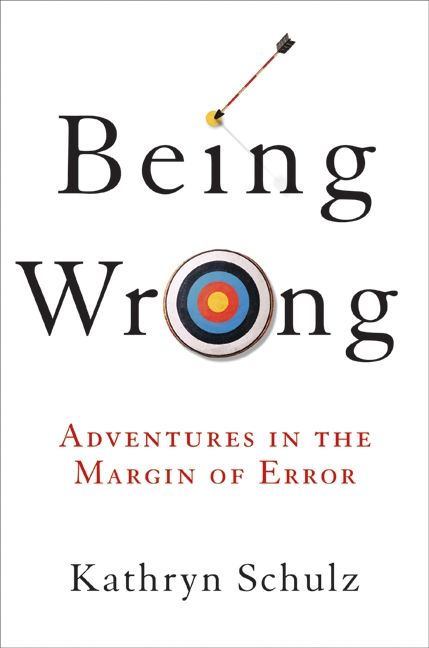
being wrong by kathryn schulzSeveral months back, my wife and I were having brunch with friends in Ditmas Park. At one point in the conversation, our friends became animated as they talked about a book by Kathryn Schulz called Being Wrong. Upon hearing some of what the book was about, I knew I had to read it, as I’d been racking my brain for months about the following dilemma:

Each of us has attitudes, beliefs and ways of relating to others that make our lives worse – yet we cling to our own attitudes, beliefs and ways of relating, often defending them at all costs. We take offense if we are questioned, and rarely do we truly seek to understand how others see things, especially if tension/conflict has ensued. In the midst of battle, we REALLY dig in our heels to defend our version of reality. In this regard, we all seem to have forgotten Socrates’ maxim: All I know is that I do not know. I’d long thought that Socrates’ relationship to certainty/uncertainty was relevant to mental and emotional health, and suddenly here I was at brunch hearing about a book that might just help me advance my thinking on the issue.

On the basis of my excitement, I proceeded to – in my mind – do something I have done, oh, about one million times in my life: I told myself that I could and would get and completely read the book that weekend. WRONG. Coincidentally, Schulz uses just such an example at the end of her story where a friend of hers promises himself that he will read all of Ulysses during a 4 week break at school. WRONG.

As it turned out, it took me a few weeks to even get around to buying the book and then a few months before I actually took it off my shelf. After finishing it this weekend, I find myself left with one overriding thought: Kathryn Schulz (not a therapist herself) has done the field of psychotherapy a great service by giving us a game-changing way to understand a core aspect of ourselves: the built in tension between our intense craving to be right and our equally powerful tendency to be wrong.

certainty and uncertainty
When we put ‘certainty’ at the center of our lives – the repeated claim that we are Right, that we Know and that OUR current version of reality in a given situation is True – it usually causes us more harm than good, in a variety of respects, but definitely in our relationships and in our inner lives. This dovetails well with an important idea in psychotherapy which is that optimal mental health is characterized more by flexibility than rigidity. Schulz’s work helps us, I think, to digest more deeply something that we may agree with intellectually but have great difficulty putting into practice in our lives, which is this: More important than ‘being right’ in our construal of reality (say, in an argument with one’s spouse) is the ability to be flexible – to stop, change directions and co-create a new narrative that allows for and supports connection, teamwork and synergy.

the prison of perfectionism
One of the main points of Being Wrong is to extol the virtue, in a genuine way, of human fallibility. Schulz goes to great lengths to give a serious and deeply satisfying account of how our vulnerabilities and imperfections are in many ways assets, and she encourages us to relate to them as such. This turns the modern epidemic of perfectionism (I must never let them see me sweat, I must keep up appearances at all costs) on its head. Her ideas are all the more appealing because she makes them with depth, humor, extensive historical references and most importantly, warmth and humility. Schulz writes:

What is true of our collective human pursuits is also true of our individual lives. All of us outgrow some of our beliefs. All of us hatch theories in one moment only to find that we must abandon them in the next. Our tricky senses, our limited intellects, our fickle memories, the veil of emotions, the tug of allegiances, the complexity of the world around us: all of this conspires to ensure that we get things wrong again and again.

As an intellectual idea, most people agree that we are all imperfect, but as a visceral and deep-down-in-the-soul experience, few of us really ‘get’ it and have integrated that reality into our hearts and minds. Who among us is at peace with our personal version of the human condition? As I have spoken about in previous blog posts, to deepen our awareness and acceptance of our own personal shadow is to create the conditions we need in order to take the creative/constructive action that transforms our lives in desirable ways – not overnight but over time. What is the shadow side of oneself? What I mean is simply the sum of the parts of ourselves we often consider to be ‘wrong,’ that we learn to hide and wish would just go away – the aspects of ourselves that are flawed, fearful, insecure, ashamed, wanting, doubtful, self-centered, compulsive, naïve and more.

lifelong learning and growth
I’ve said it before and I’ll say it again (and again and again): Learning and growth are lifelong (if we so choose), and they result from a daily practice of conscious, reflective and purposeful living. Schulz helps us see ever more clearly that such a path is characterized less by the repetition of grand successes and more by honest and consistent recognition of the incidences where we make mistakes, get things backwards, fall short of our ideals, hurt others, neglect ourselves and generally make a mess of things. This reflective practice improves our lives so dramatically because when we can regularly admit that we are wrong, we replace rigidity with flexibility and creativity, and this is exactly the framework and skill set we need if we are serious about becoming better friends, spouses, workers, parents, bosses, artists, members and citizens.